Shibari Workshop for Couples in Berlin: Trust, Intimacy and Rope
The first surprise in a good Shibari workshop for couples in Berlin is usually not the rope. It is the silence that arrives when two people slow down enough to actually feel each other. Before any pattern, before any aesthetic shape, there is breath, attention, consent, and the subtle negotiation of trust.
That is why the right workshop is never just a class about tying knots. It is a guided space where technique meets presence. For some couples, that means discovering a new sensual language. For others, it means learning how leading, receiving, communication, care, and surrender can become more visible through the body.
At Shibari Studio Berlin, our Tantric Shibari workshops for couples are designed for beginners and curious partners who want to explore rope through trust, presence, sensuality, clear consent, and intentional guidance.
Why couples are drawn to Shibari
Shibari has an immediate visual charge, but its deeper pull is relational. Rope creates structure. Within that structure, many couples notice dynamics that are otherwise easy to miss — hesitation, overthinking, tenderness, impatience, protectiveness, the desire to lead, and the desire to let go. A Shibari workshop for couples gives those dynamics form, and with the right facilitation, that form becomes something you can work with rather than react to unconsciously.
For couples, this matters because intimacy often suffers from familiarity. Not necessarily a lack of feeling, but a lack of attention. Ritualised practice interrupts habit. It asks one partner to offer direction with clarity and the other to receive with honesty. Both are invited into accountability. Both are asked to stay present.
This is where Shibari becomes more than decoration. It can sharpen communication, deepen erotic intelligence, and reveal the difference between performance and genuine connection. That does not happen automatically, of course. It depends on the quality of teaching, the atmosphere in the room, and the willingness of both partners to approach the experience with curiosity rather than expectation.
For couples visiting Berlin, a Shibari workshop can also become a memorable alternative to the usual date night, spa visit, or weekend activity — something intimate, artistic, and deeply personal.
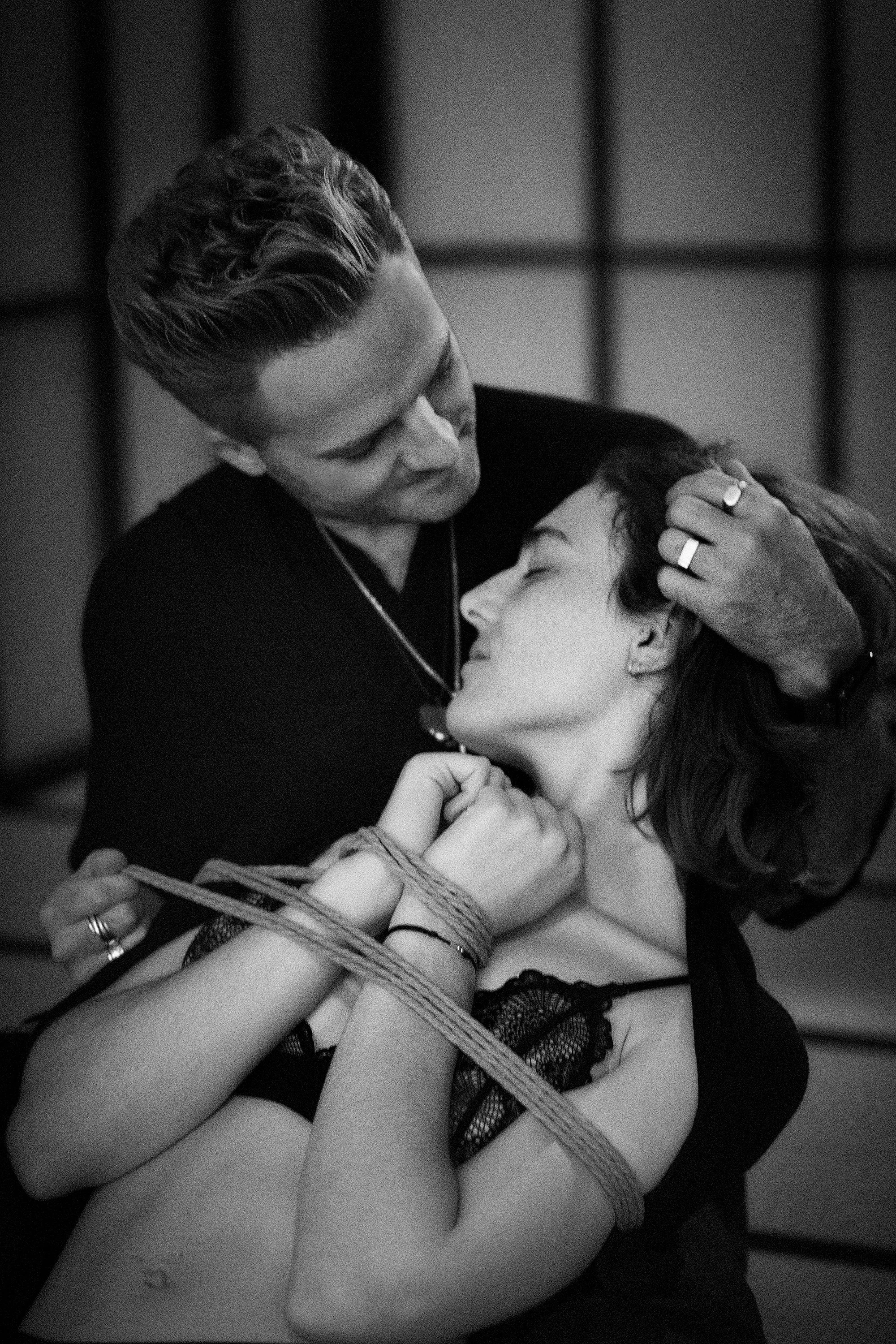
Dan Carabas and his partner Dorcara, shot at Shibari Studio Berlin
What happens in a Shibari workshop for couples
A well-designed Shibari workshop for couples usually begins long before anyone is tied. There is orientation, framing, and a clear agreement around safety. You may be guided through basic rope handling, body awareness, consent language, and partner check-ins before moving into simple ties.
For beginners, this pace is essential. The point is not to rush towards complex positions. The point is to build a felt sense of trust. Learning how to place rope with care, how to observe breath and circulation, and how to respond when something does not feel right creates the foundation for everything else.
Exercises may include simple wrist ties, body-based floor work, slow rope placement, guided breath-led pauses, partner feedback, and basic patterns that help couples understand tension, contact, weight, and communication. The work is practical, but the experience is never only technical.
In many couple-focused settings, the exercises are chosen not only for technical accessibility but for emotional clarity. One partner may practise leading with calm precision while the other explores receptivity, feedback, and surrender. Then the roles may reverse. That exchange can be unexpectedly revealing. People often discover that what they imagined would feel natural is not always what actually does.
More experienced couples may look for a workshop that goes further into intention, polarity, restraint, aesthetic line, floor work, or the emotional arc of a scene. Here, the value lies in refinement. Not more intensity for its own sake, but more consciousness. Better touch. Better pacing. Better reading of the person in front of you.
The emotional texture matters as much as the technique
A common mistake is to think of rope as a skill first and an experience second. In partner practice, it is both at once. The technical side matters because safety matters. Yet the emotional texture of the session matters just as much. How you enter. How you make eye contact. How you speak. How you pause. How you end.
For couples, these details often become the real teaching. A simple chest harness can feel mechanical in one room and deeply intimate in another. The difference is usually not complexity. It is quality of attention.
This is why an artist-led, embodied approach can feel so different from a generic class format. When Shibari is taught as a relational and aesthetic language, couples are not only shown where the rope goes. They are invited to understand what the rope is doing — emotionally, visually, energetically, and psychologically.
That said, not every couple wants the same thing. Some arrive with a strong sensual charge and want a contained way to explore it. Others are more interested in communication, trust, artistic practice, or body awareness. Neither approach is more valid. The workshop should simply be clear about its frame. Ambiguity can create disappointment. Precision creates safety.
How to know if a workshop is right for you
The best choice depends on where you are as a couple and what kind of guidance you need. If you are new to rope, look for a workshop that explicitly welcomes beginners, includes hands-on safety instruction, and does not treat intensity as a badge of seriousness.
If you already practise together, you may want a format that offers more nuance around embodiment, transitions, floor work, suspension preparation, or the emotional architecture of a scene.
It is also worth paying attention to the teaching style. Some spaces focus almost entirely on mechanics. Others bring in consent practice, somatic awareness, polarity, partner communication, and aftercare. For couples, the second approach is often more meaningful because it reflects the reality of intimate rope. Technique without relational intelligence can become brittle. Chemistry without structure can become careless.
The room itself matters too. A refined, well-held environment changes how people learn. When the atmosphere is calm, intentional, and aesthetically considered, couples often settle more quickly into their own experience. They feel less observed, less hurried, and more able to notice subtle shifts.
In our premium workshop space in Berlin-Mitte, this curation is part of the teaching. The environment supports the practice rather than distracting from it. For many couples, that makes it easier to move beyond self-consciousness and into genuine presence.
Safety is part of intimacy, not separate from it
Any honest conversation about Shibari must include safety. Not as a dry disclaimer, but as a central expression of care. Rope affects nerves, circulation, balance, and emotional regulation. A Shibari workshop should cover the essentials clearly, without dramatics and without complacency.
That includes knowing which areas of the body require caution, how to recognise numbness or tingling, how to communicate quickly if something changes, and why cutting tools should always be available when practising rope. It also includes emotional safety. Being tied can bring up vulnerability, exhilaration, resistance, or unexpected emotion. A skilled facilitator knows how to normalise this and keep the space grounded.
For couples, safety can actually deepen sensuality. When both people trust the frame, they can relax into the experience more fully. Boundaries become supportive rather than restrictive. Clear consent becomes part of the seduction, not an interruption of it.
If you are starting your own rope practice at home, the right material also matters. A beginner-friendly rope set, ready to use (singed and oiled), such as the NewAsa jute rope set is a good choice.
More about safety in our article: Rope Safety in Shibari
How to prepare before you arrive
Come rested, hydrated, and with enough time to arrive without rushing. Wear comfortable clothing that allows movement and direct contact with the rope where appropriate. Avoid treating the workshop like a performance. You do not need to be impressive. You need to be available.
It helps to talk beforehand about your intentions. Are you coming for play, learning, reconnection, curiosity, or challenge? You do not need a perfect answer, but a shared orientation creates steadiness. It is also wise to speak about limits in advance. What feels exciting, what feels uncertain, and what is off the table for now?
If one partner is more enthusiastic than the other, that deserves honesty. A workshop can be a beautiful place to explore difference, but it should not be used to drag someone across a threshold they have not chosen.
What couples often take home
The visible result may be a new tie or a stronger technical foundation. The more lasting result is often subtler. Couples leave with a clearer sense of how they relate under pressure, how they ask for what they want, and how they care for each other in states of heightened sensitivity.
They may also leave with a new aesthetic vocabulary. Rope can change how a couple sees the body, posture, line, stillness, and restraint. It can introduce visual storytelling into intimacy — not in a staged way, but in a way that makes desire feel more deliberate and more beautifully held.
And sometimes the greatest value is simply this: a workshop creates a dedicated moment in which intimacy is treated as something worthy of craft. Not rushed. Not improvised in the leftovers of the day. Crafted, with attention.
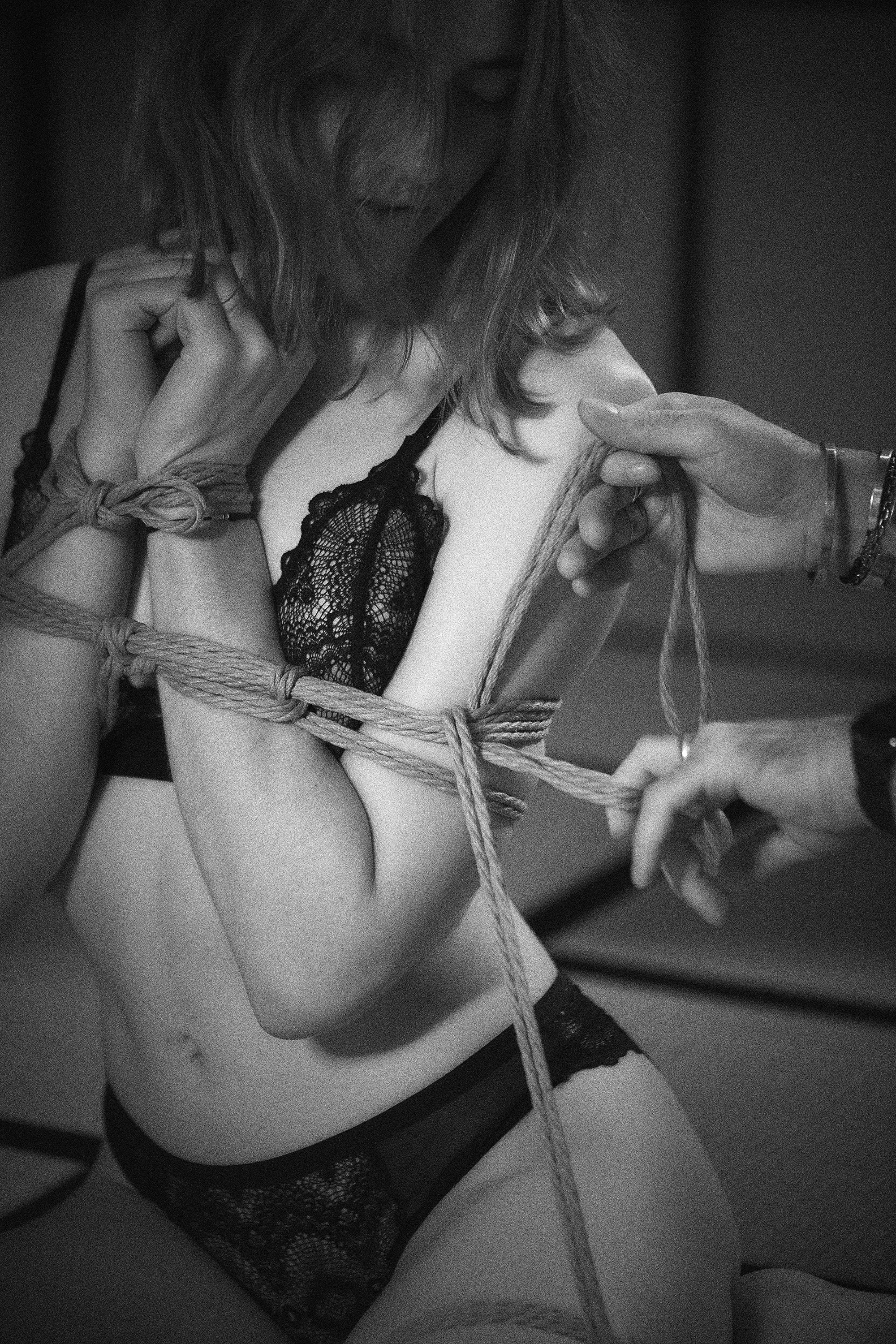
Join a Tantric Shibari workshop in Berlin
If you are looking for a Shibari workshop for couples in Berlin, Shibari Studio Berlin offers intimate, beginner-friendly workshops guided by Dan Carabas. The experience combines rope technique, consent, breath, partner communication, sensuality, and aesthetic practice in a refined studio environment.
You can join a group workshop with your partner or book a private Shibari tuition if you prefer a more personal setting. Both formats are designed to help you explore rope safely, slowly, and with intention.
For couples who feel drawn to rope, this experience can be transformative. Not because Shibari promises some magic tricks, but because it asks for something rarer: presence, skill, trust, and the courage to let connection become visible.
Experience Shibari in a guided setting.
Presense
•
Polarity
•
Connection
•
Small group of max. 4 couples
•
A guided intimacy practice in Berlin-Mitte
•
Presense • Polarity • Connection • Small group of max. 4 couples • A guided intimacy practice in Berlin-Mitte •
Ready for a 1:1 experience?