Shibari Beyond Technique: Alexander Ma & Natasha NawaTaNeko on Kinbaku, Somatics and the Art of Feeling
In this in-depth interview, we speak with Alexander Ma and Natasha NawaTaNeko, Berlin-based artists, educators, and founders of Discover Kinbaku. For over a decade, they have been exploring rope as a lived practice — performing, teaching, and publishing through their Kinbaku Society magazine.
Their work goes far beyond technique. Rooted in influences such as Semenawa and the artistic legacy of Naka Akira, their approach focuses on rope as a medium for emotional intensity, intimacy, and embodied experience.
Natasha, author of Somatics for Rope Bottoms, brings a crucial perspective often overlooked in rope discourse: the inner world of the person being tied. Together, they shift the conversation from how rope looks to how it feels — and what it reveals.
This interview explores Kinbaku as an evolving practice between tradition and transformation — shaped by presence, communication, and the search for authenticity.
Who are you and how do you like to be introduced?
We are Natasha NawaTaNeko and Alexander MA, a Berlin based couple in a committed relationship and Shibari enthusiasts. We share, perform and teach globally.
How did rope first show up in your life, and what made you stay?
For Alexander, the fantasy of capturing women was there even before adolescence. Of course, in our cultural context this was not a “Kinbaku” fantasy - and also later after I entered the Sex positive and conscious kink scene, bondage stayed functional. Only with a private session he witnessed on New Years Eve night 2008 everything changed: he understood the power of rope bondage as connective, erotic practice.
Natasha was “innocent”until she met Alexander, 3 years after this event. A photograph on the wall caught her interest. The rest is history…
You have been working together for many years as partners in life and rope.
How has your dynamic evolved over time?
Actually our “dynamic”didn’t change much over time. Then and now, it’s quite simple: Natasha loves to get tied by Alexander, Alexander loves to tie Natasha.
What has evolved is how we express this passion. We are more clear about our intentions, about our desires and limits. We have a much wider toolbox to adapt to the moment, to express what is felt in that moment. We have much more capacity to focus on our dynamic, on our communication - to PLAY - than we had initially, as a natural consequence of practicing so much together.
What does Kinbaku mean to you at this moment of your life?
We strongly believe that one cannot choose this kind of passion - the passion chooses you. Through researching and practising Kinbaku, many meta-topics and themes of our lives came to a point making sense: our interest in embodiment and somatic research, our passion for education and for being on stage. Our fascination with Japanese philosophy and culture. Finding beauty in the margins and liminal spaces and making art out of the feeling of being misfits, for all the other misfits out there.
How would you describe your rope in three words — and why these three?
(Ogawa Jute untreated) :)) Kiddin'
Ritual, Polarity, Intimacy: This is what it probably always was and how it evolved over time, beyond the external aesthetic display.
We experience rope bondage as a very powerful tool to dive into an intimate communication between human beings, which by its very nature exposes the polarity of the chosen roles within that dance.
If you could clear up one big misconception about Shibari or Kinbaku, what would it be?
It’s about how it feels, not about how it looks.
Deep-Dive with Alexander
Your work often references Semenawa and the lineage around Akira Naka. What draws you personally to this style of rope?
I had a picture of Naka Akira on my wall, much before I was even into Kinbaku. (The famous one, from Araki). But I don’t even know any more, if I still do proper Semenawa. And I definitely have no name in Naka San’s lineage, no status as Deshi or acknowledged student… I just love his art. I admire his meticulousness, his attitude, his precision, his craftsmanship, and his search for beauty in Kinbaku. Right from the beginning I loved his interpretation of Kinbaku (his Semenawa) because it aimed for dignifying the model, in all that suffering. Naka-san talks a lot about empathy and “being a masochist” when he ties - and this resonates with me.
How did your technical style evolve, who or what shaped the way you tie?
Initially, I struggled a lot to find my style. The first 6-8 years I was mainly confused. I knew what was inspiring to me: the Semenawa of Naka Akira. But around me, everyone did different types of Shibari at that time and I was told that THIS style was only for professionals, only for very masochistic models, only for the few and chosen ones.
Only after I met Riccardo Wildties did I find a solid technique, which is in my opinion the fundamental of good Kinbaku. I studied with him for 5 years, which basically laid the technical foundation of my style. Since I left him as a student and instructor, I found freedom to create my own interpretation of Semenawa, formalized under the “Bodies under pressure” concept.
I use ropes to tie - challenge - the somatic body. In this respect, tying is processual: Shibari. Also, my intention for a session shifted from a fixed, pre-determined goal to an adaptive feeling into the moment and creating on the spot what wants to get manifested.
When you start a session, what are you actually looking for in the person you tie?
Beauty. Maybe a shy smile. Maybe moving hands that reveal nervousness otherwise hidden. The dress, revealing or hiding a body part. Blushing. Something that inspires me to make my first move.
Do you plan the structure of a session — or do you improvise and respond moment by moment?
Every session has a preludium, a beginning, a middle part, and an end. And then the aftermath… That’s the structure. Within it, I improvise and respond to the moment.
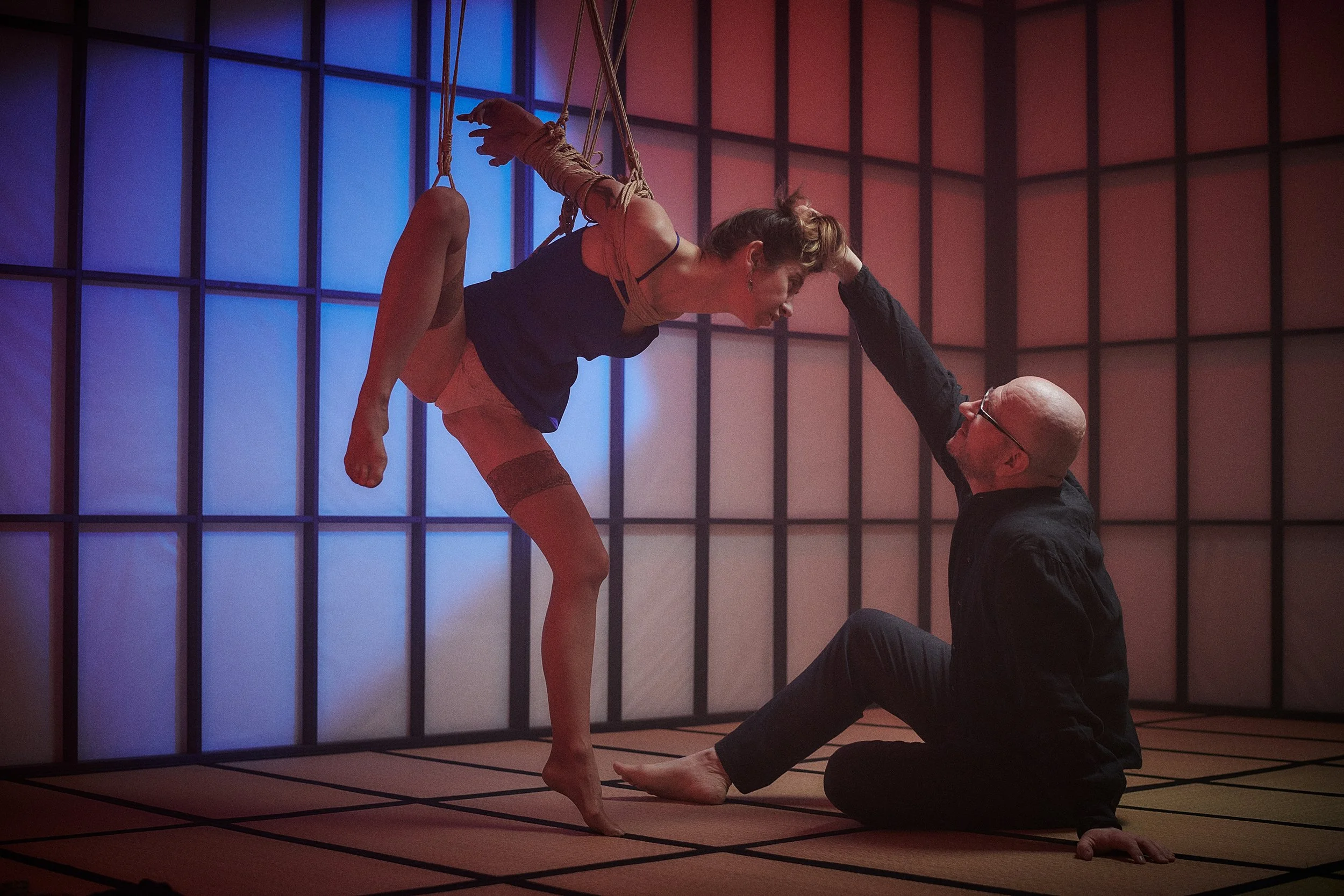
Natasha NawaTaNeko & Alexander Ma shot at Shibari Studio Berlin by Dan Carabas.
Deep-Dive with Natasha
You wrote Somatics for Rope Bottoms, which explores the inner experience of being tied. What originally inspired you to write this book?
Somatics, to me, is about living with dignity (with choice, with agency) as opposed to living by the external framework, so conveniently offered to us by the society that tells you how you should behave, how you should look and how you should feel.
We adopt this external frame from a very young age and we learn to look at ourselves from a third-person perspective, we learn to operate within a mechanical Cartesian view of the world (body is a tool to perform, a resource). When it doesn’t, we judge - ourselves and others, we try to comply and bend ourselves, we feel inadequate. It holds us back from living our life fully, from offering our gifts to the world.
Much of that separation and objectificazion is facilitated through adopting the third-person perspective and how we approach education, medicine, psychology, science in our society. It pains me to see the consequences of this in the world today.
Through this book I wanted to remind people - in this case my community, rope enthusiasts - that they are worthy of kindness and compassion, and that they have a choice. It opens through paying attention to the life of our bodies. This is where we can find our truth, safety, and guidance. And this is as true in rope bottoming as it is everywhere else in life.
Many rope discussions focus on riggers and techniques. Why is the bottom’s experience so important to talk about?
Well this practice involves two people, doesn’t it. When we just started with ropes, no one would ever talk to me, as a rope model. I was literally a “model” - for practicing knots and harnesses and it left me very confused.
The magic does not happen on the rigger’s side - it happens in the body of the person being tied. The emotional, psychological, and physical experience of the bottom is what ultimately gives the practice its depth and meaning.
There is much more awareness nowadays about the bottom’s side of rope. I’m happy if my work has been able to contribute to that dialogue.
What does good bottoming look like to you?
Good bottoming, to me, is about an authentic expression.
Also, we don’t have to be “good” :)
It’s about allowing yourself to feel what is actually happening in your body and expressing it honestly. Not performing, not trying to please expectations, but staying present with your own experience. From that place, the rope can become a real dialogue between two people.
Has rope changed your relationship with your body? If yes, how?
Oh my god, yes. It changed everything for me.
I started from quite a disembodied place. I was mostly confused and expected my partner to do the work. Through rope, over time, I learned to show up for myself. I learned agency and responsibility for my own experience.
I learned to feel, to trust, and communicate my desires as well as my limitations. I learned how to process emotions.
Rope became a kind of dojo for me - a practice space where I could face my resistance (habits, fears...), learn to trust, to open up to the experience and let the current go though me.
In a way, it has become a practice of finding my way to myself.
What do you wish more riggers understood about bottoming?
I have two things :)
Less is more. Don’t do too much, don’t try too hard.
It’s okay to pause. We are not bored. Often the most meaningful moments happen when the rigger slows down enough to actually listen and observe what is happening in the body of the person they are tying.
Also I wish more riggers understood that they cannot control our experience. Rope is not mechanical. It’s not like: if I make the shape “A”, the bottom will feel emotion “B”. There is a mystery - and a history - living in the body of the person being tied.
More than anything else, we want our partners to show themselves as they are and to be present with what is really there. And we can always feel when something is forced - when someone performs moves instead of being genuinely present.
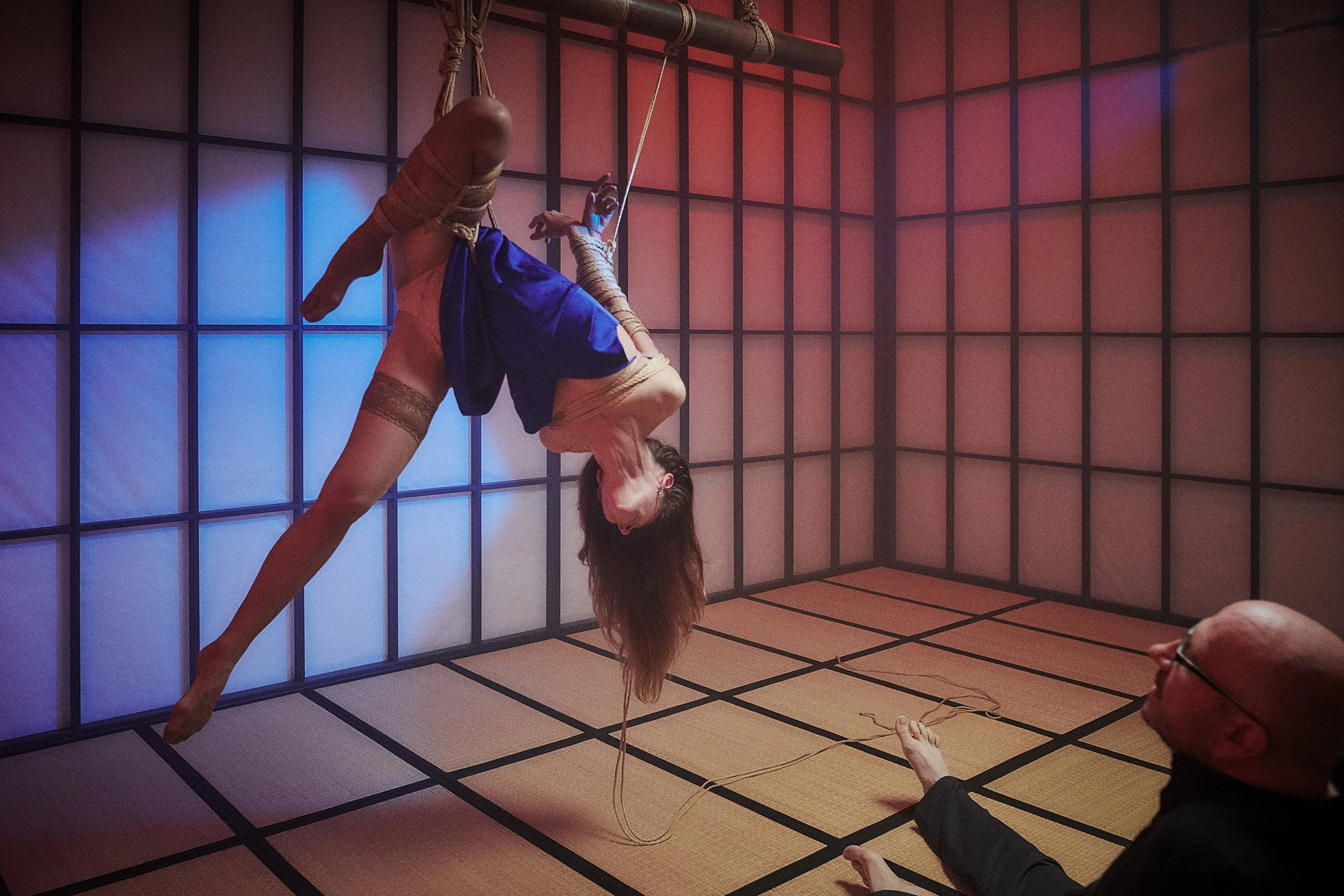
Natasha NawaTaNeko & Alexander Ma shot at Shibari Studio Berlin by Dan Carabas.
Questions for Both
You founded Discover Kinbaku and also created the Kinbaku Society magazine. What motivated you to start publishing about rope?
Discover Kinbaku is our educational project. Of course, we believe we bring unique didactics, a personal approach, and a lot of experience. But in the end: it is one project amongst many that provide education around rope bondage.
The magazine is something quite unique. It brings together voices from both within and outside the scene to reflect on Kinbaku as an underground culture. The magazine is not about rope (styles, technique, lineages, etc.) but about people, both dead and alive, their stories, their motivations.
The content we curate often reflects a shared feeling of loneliness, of being a misfit, not understood, being somehow differnet than the mainstream: hentai! - and then finding home in such a strange world of rope bondage community. But it could also be another underground scene: traditional tattooing, contenporary dance like Butoh, noise, … We are interested in those margins and liminal spaces in general - Kinbaku being one of their expressions.
Also, we are very particular about creating an analog, haptic object - not a product! We put great care into the choice of paper, the binding, the finishing, etc. Every issue has its own design, as we invite different designers to craft it to their vision. We print in limited edition, and deliberately refuse to make it digitally available or to reprint.
We are very proud of the fact that we started this movement, publishing since 2019. Still now, there are only two more print magazines dedicated to Kinbaku, Yugen Magazine, published in Milan and Roca, published in Japan. We wish there would be more...
How has the Kinbaku scene changed in Berlin since you first arrived?
When we arrived (2014) Berlin was one of the hot spots of the European scene, with “Schwelle 7” as one of the main venues, with regular classes, EURIX and international (Japanese!) presenters. At the same time, the Berlin scene was already very diverse. The very traditional Osada Kinbaku Dojo coexisted with female, queer artists & educators like Kristina Marlen and Dasniya Sommer. Also, Tantra and other esoteric practices already infused Shibari at that time. What we always found fascinating and appreciated was the fact that the scene remained relatively low in conflict, despite the vast diversity of approaches.
Since then, we have witnessed a massive change. Berlin lost its role as the “lighthouse”of the scene… For a long period, Berlin didn’t have a large venue focusing on Shibari or Kinbaku. International events and well-known educators went to Copenhagen, Antwerp, Prague, Milan and other new venues across Europe. For a long time, our home-studio 6x6, with 4 bamboo, was on the upper size spectrum of rope spaces in Berlin. Many people had 2-3 hanging points in their home, hosting small(er) more or less private study groups, jams, events. In this respect, the scene diversified even more. On one hand, that’s amazing, as everyone can get exactly what they need to their taste in Berlin. On the other hand, in my observation, the technical level (and unfortunately the physical safety standards) is underdeveloped in comparison to other metropolitans in Europe.
Very recently, the bigger venues came back to Berlin, providing more opportunities for workshops with internationally renowned educators. Today the Berlin scene is even more queer & female than it already was in 2014. I just hope that in the future Berlin comes back to the “lighthouse” role it had been a decade ago whilst maintaining the spirit of coexistence we valued so much when we first arrived here.
What are you currently researching or exploring in rope that excites you?
The somatic aspects of rope bondage as embodied practice are an ocean of endless depth, we are just starting to scratch on the surface. Everyone talks about “connection” - but what does this really mean? How do we communicate through rope? How do we show up for the session, in the session, throughout the session? How do we get present with the moment, with what there truly is - and get rid of all those external stories we get hypnotized with everyday through the culture we immerse ourselves in, through social media and their influencers?
As a couple this excites us - in a very practical way. Still, after tying together for more than 14 years, after performing and educating professionally for 8 years - when we get on the tatami, under the mild, hazy morning light to tie, just to tie for us, it is as exciting as it was in 2012, when we tied for the first time.
Do you think Kinbaku is evolving into something new in the West, or are we still trying to understand the original Japanese language of rope?
We think we all, Japanese and non-Japanese alike, are still searching. Shibari culture in the West very much deviated from its roots in Japan (and also from “Western Bondage” roots, that equally are in the BDSM realm). But nowadays also in Japan a young(er) generation mix Shibari with less sexual practices than the forebears did.
We are in a very beautiful - liminal (sic!) - space. We studied the Japanese tradition a lot, and technically there is nothing they can do that “we” cannot do. In our opinion, also influenced by the conversations we have with our Japanese teachers and friends, it is time for us (Non-Japanese) to leave to Japan what belongs to Japanese culture and find our own way.
To quote Sugiura Norio Sensei, a man we deeply admire: “You have beautiful architecture in Europe, beautiful light, beautiful women (“people” I would translate) - do something with it. Create your own Kinbaku.” And I think that’s exactly what we shall do.
But - we need to add: make it more beautiful - not degenerate it… That’s our wish for the next decade…
When you perform or teach together, what is the dialogue between rigger and model that people often miss?
Actually, when we perform or teach - it is all about the dialogue. And it seems to be that people get it and appreciate it.
If someone wants to explore being tied for the first time, what would you tell them?
Take your time and make your experience with a person you feel really connected, intimate with, a person you feel you can trust. Don’t let “greed” lead you into a situation tying with someone “just available” and later regretting it. When you want to explore the sensation of being tied, when you wish to have an “experience” - consider booking a session with a good professional.
What is one thing you wish you had known at the beginning of your rope journey?
Life is short - go for your passions before it is too late. Which is a strange answer, because we “knew” this already at the beginning of our journey. And still, we hesitated initially to invest in good education. For too long we used “no money” as an excuse not to go to Japan. For too long we felt we were not good enough to perform. Etc.
If your rope style were a movie, a book, or a piece of music, what would it be?
It would be a melodramatic, non-linear narrated, cinematic visualized movie about killing what you love, loving what is killing you and unconditional love prevailing death, temporarily.
And finally: What keeps rope fascinating for you after so many years?
It's unescapable power forcing you into the here and now becoming authentic with what is. In ropes, with ropes, through ropes - one cannot lie.
In Summary
This conversation with Alexander Ma and Natasha NawaTaNeko reveals Kinbaku as more than an aesthetic or technical discipline — it is a relational, embodied practice rooted in presence, trust, and emotional depth.
From the intensity of Semenawa to the somatic awareness of the rope bottom, their work emphasizes that the meaning of Shibari emerges not in the rope itself, but in the lived experience between two people.
Their perspective also reflects a broader shift: as Shibari evolves in the West, the question is no longer how to replicate Japanese traditions, but how to develop an authentic, culturally rooted expression without losing depth or integrity.
For anyone exploring Shibari in Berlin or beyond, this interview offers a clear insight:
rope is not something to perform — it is something to experience.
More from them here: discoverkinbaku.com
The Magazine: The Kinbaku Society of Berlin Magazine
Experience Shibari in a guided setting.
Presense
•
Polarity
•
Connection
•
Small group of max. 4 couples
•
A guided intimacy practice in Berlin-Mitte
•
Presense • Polarity • Connection • Small group of max. 4 couples • A guided intimacy practice in Berlin-Mitte •
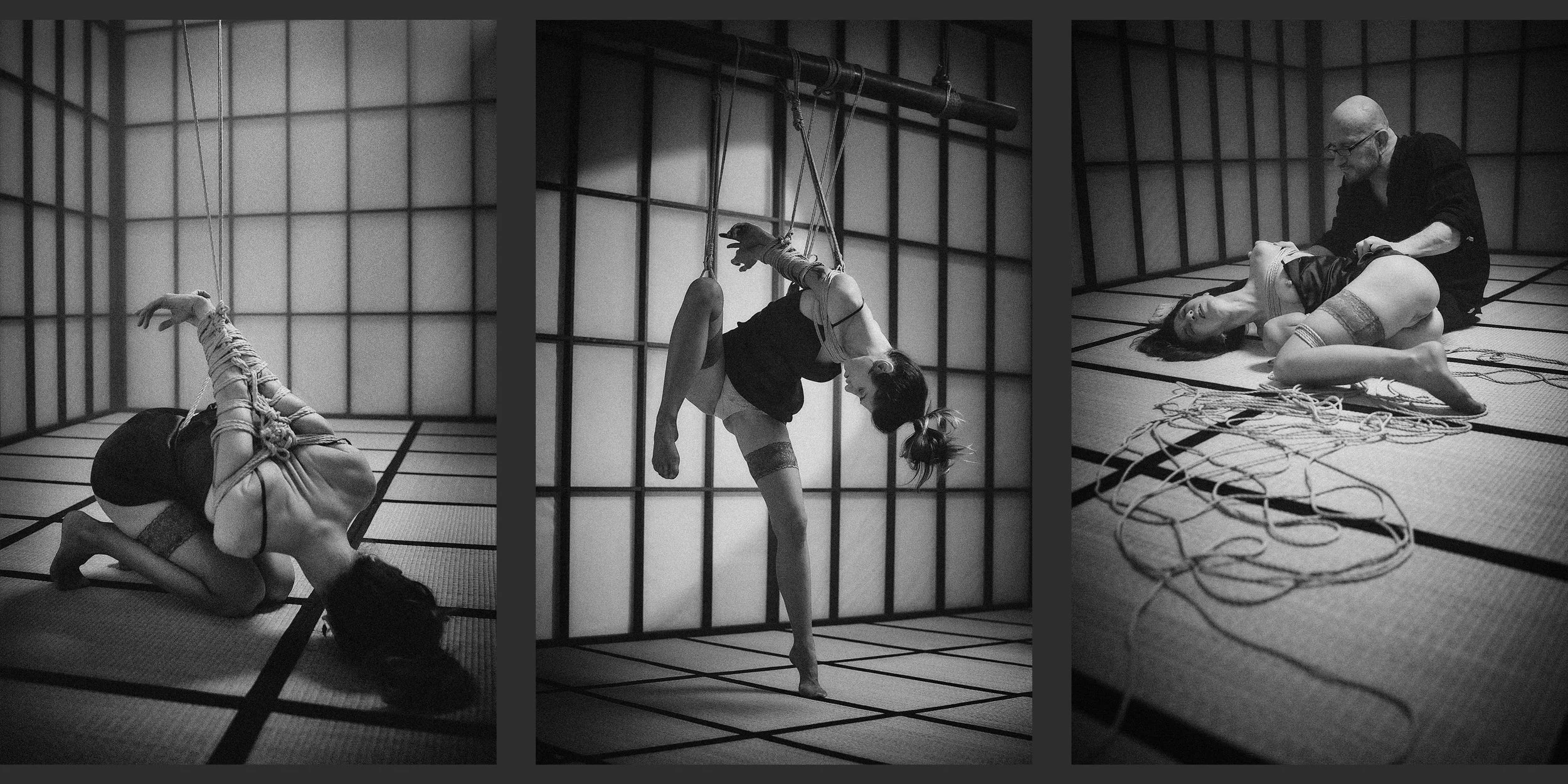
Natasha NawaTaNeko & Alexander Ma shot at Shibari Studio Berlin by Dan Carabas.
Ready to go deeper, experience a 1:1 setting?