Inside the mind of rope artist Frank – Male Shibari.
For Frank — known online as Male Shibari — Shibari and Kinbaku are not simply practices, but a daily exploration of connection, aesthetics, and emotional intensity. His journey began more than twenty years ago, sparked by the haunting imagery of Japanese photographer Nobuyoshi Araki. What first appeared as visual fascination gradually evolved into a lifelong study of rope bondage as an expressive art form.
Influenced by masters such as Naka Akira, Kanna, Gorgone, Ropunawa, Tamandua, and Alexander Ma, Frank developed a tying style that balances precise rope technique with emotional presence. For him, rope is a powerful tool — one capable of shaping physical sensation, psychological tension, and visual storytelling at the same time.
In this interview for the Shibari Studio Journal, we talk about artistic influences, rituals before a session, safety and trust in rope, and the unique way Frank merges Kinbaku, photography, and intimacy into one unified creative process.
Who are you and how do you like to be introduced?
My name is Frank, known on social media as Male Shibari.
How did rope first show up in your life, and what made you stick around?
More than 20 years ago, I visited an exhibition by the photographer Araki together with an artist. His Shibari images immediately captivated me and touched me deeply. At the time, however, I couldn’t quite put into words what it was that moved me so much.
Ten years later, I discovered a fascinating book about rope bondage in a bookstore and had to buy it right away. I quickly realized that it takes a great deal of practice to be able to express oneself through rope.
Together with my first teacher, I attended the first workshop with Nurio Shuiura at the Kinbaku Lounge, which had a lasting impact on me. Kanna San, Gorgone, Ropunawa, Tamandua, Naka San, and Alexander Ma have also strongly influenced me – and I am still learning from them.
What does Shibari mean to you at this moment of your life?
Kinbaku and Shibari are a part of my life that I engage with intensively - on a daily basis.
How would you describe your rope?
When I work with rope, I experience it as a powerful and potent tool with which I can create an intense physical and emotional space between my partner and myself. Every touch, every tension can evoke deep sensations and immediate reactions.
I see myself as a reaction fetishist for whom, alongside the physical and emotional dynamic, the overall aesthetics and the precise guidance of the rope are very important.
If you could clear up one big misconception about Shibari, what would it be?
For me, it is important to reflect on why I want to tie with a particular person and which figure or path I choose, or rather what I want to achieve or evoke with it. Despite all my devotion to aesthetics, Shibari/Kinbaku is never just form for the sake of form for me - never mere decoration. For example, do I really need to incorporate another bamboo somewhere simply because it looks stylish, or does it truly serve a function that goes beyond aesthetics?
How did your technical style evolve and who or what shaped the way you tie?
My first teacher taught me a TK by Osada Steve, but I quickly recognized its limitations and switched to a stem less. Kanna San, Gorgone, Ropunawa, Tamandua, Naka San, and Alexander Ma have also strongly influenced me – and I am still learning from them.
Do you have a pre-scene ritual as a rigger, or how do you bring yourself into the right head-space?
It varies greatly. Sometimes I correspond with people for years before we finally meet in person.
For a session in my studio, where photos will also be taken, there is a TFP agreement. It’s sent in advance, with a personalized stamp and seal, always by post. In a way, it marks a ritual at the beginning.
Other times, when I’m at an open jam; after a brief conversation, we simply begin. Touch and tenderness, taking time to “warm up” with the other person- an embrace is very important to me. I enjoy working with a fundoshi, and putting on / tying the cloth is also a ritual for me.
How do you tie in a session – what influences it, and do you plan ahead or go with the flow?
Depending on who I’m tying with, how well I know the person, the purpose of it, and the intention I have for a session, I sometimes plan an entire choreography or simply a starting position. And even within a planned choreography I go with the flow. The most blissful moments and sessions are the ones where everything simply flows and unexpected turns arise, allowing us to dive deeply together into subspace.
Where did you start in rope – tying or being tied – and what made you switch sides?
I started actively tying up other people. From time to time, for practice purposes, I’m also on the passive side. After some unpleasant encounters, I’ve recently allowed myself to be tied up now and then - and I’ve really enjoyed it.
How does your headspace change when you move from top to bottom (or the other way around?
When switching, control shifts in a very significant way. As a model, I hand over quite a lot of control to my rigger. That said, I’m certainly not an easy model - I have very clear ideas about what is allowed to happen to me in a session and what is not. At the same time, I have a strong technical understanding of what can potentially go wrong.
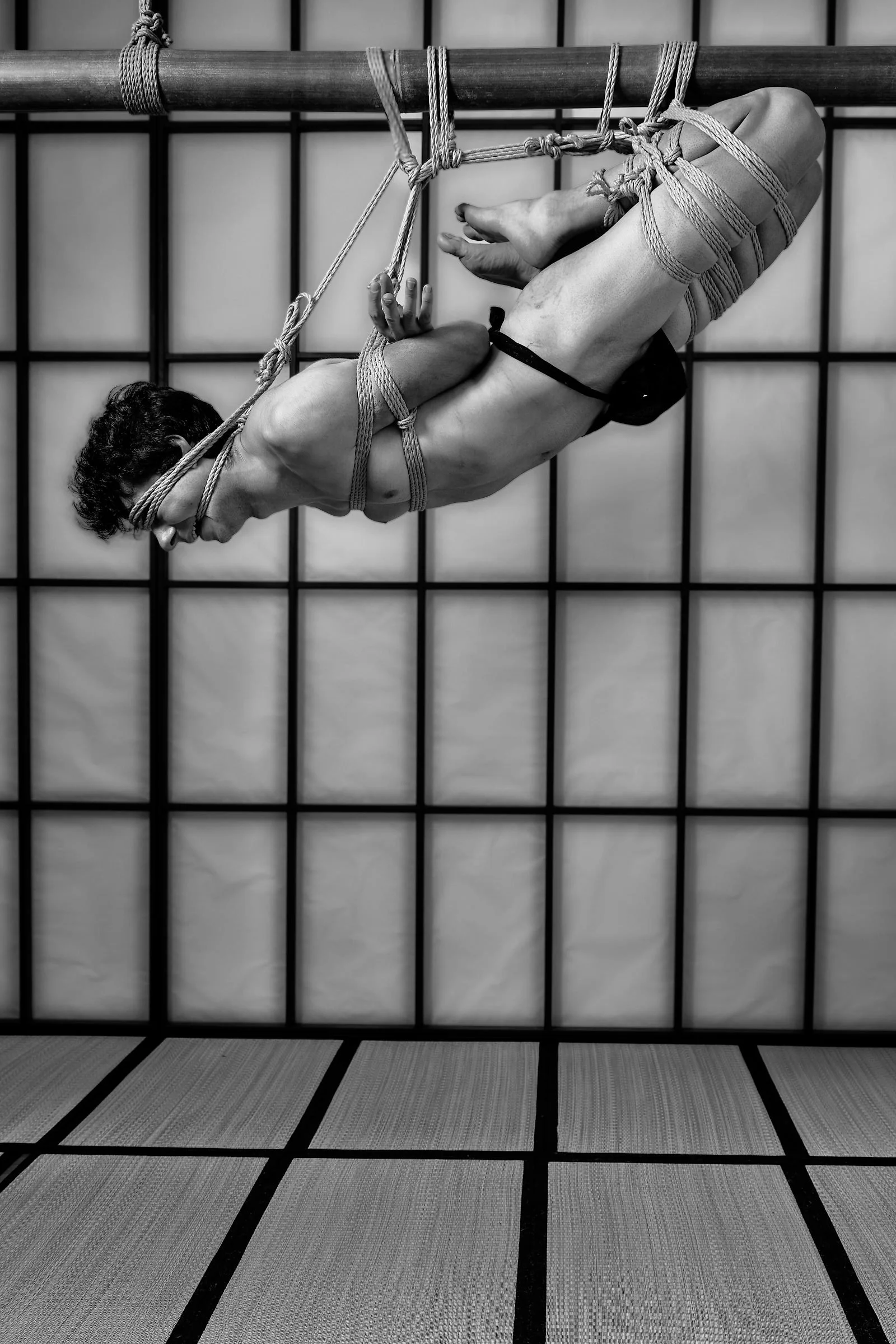
Ropes and photography by MALE SHIBARI, model Allan, shot at Shibari Studio Berlin
How would you describe your photographic signature style? Who inspired you?
My photographic language is deeply influenced by Caravaggio and Rembrandt - particularly in my use of Chiaroscuro and color. I am fascinated by the way light can sculpt emotion. Through deliberate lighting and framing, I guide the viewer’s gaze toward what feels most essential within the image. Sometimes this happens subtly, almost invisibly; at other times, it is unmistakably intentional. A clear visual language that has its roots in Japanese culture, yet unmistakably embodies a European style, is my goal. So while my photographs feature tatami mats and a bamboo pole bearing my hanko, they deliberately avoid additional elements such as masks, folding screens, a tea set, or a chrysanthemum.
What has shaped your working methods in your studio, and what makes them unique?
A workshop with Nurio Shuiura sensei at the Kinbaku Lounge left a lasting impression on me. It clarified not only aspects of the aesthetic I feel connected to, but also what I consciously want to approach differently. That experience helped define my own path.
Before a session begins, I often prepare extensively - sketching ideas, developing concepts, imagining emotional directions. Yet I never treat these ideas as rigid plans. In the moment, I decide what feels right, and I involve the model closely in that process.
Traditional Kinbaku photography is often a collaborative production with a full team - photographer, model, riggers, lighting technicians, stylists, assistants. It becomes a coordinated event. My approach is fundamentally different.
For me, intimacy is essential. That intimacy can only emerge when the model and I are alone in the studio. Every image of mine that is publicly visible has been both tied and photographed by me. With one exception - waterboarding. I work without assistants or additional photographers. This independence allows a depth of emotional expression that would not be possible in a larger production environment.
When designing my studio, I focused on being able to work alone with my model in a safe way, while needing to devote as little energy and attention as possible to the photography itself. That’s how I came up with the idea of making my bamboo and the hashira horizontally rotatable by 360 degrees. From a technical standpoint, I’ve set things up so that I can fully focus on my model and the session, and taking the photos requires very little of my energy — it practically happens alongside everything else.
Good music that inspires me is important. Everything in this room serves a single purpose: to create emotional presence and to capture it in an image.
Your signature look often uses a full-black background. How did it feel to shoot at Shibari Studio Berlin with our distinct design, textures, and atmosphere?
The lighting conditions, the background, and even the distance between the camera and the bamboo in your studio are very different from my own. That was exactly what made it such a wonderful challenge for me: on the one hand, I wanted to capture the unique atmosphere of the space, and on the other, maintain my own photographic style. To be on the safe side, I had brought my own lighting (Briese), but in the end I rebuilt the setup almost entirely from scratch. The atmosphere in your studio is very free and open – I felt comfortable and welcome from the very first moment. Thanks to your help with the setup, I was able to realize everything despite the tight schedule and, within a relatively short time, complete three sessions with two models I hadn’t met in person before – tying and photographing them.
Was there one specific moment during the shoot where you thought: ‘Okay, this space is changing my usual language’?
Including the background while still keeping the focus on my model is definitely a challenge. Making sure the background enhances the image without distracting too much from the model requires a careful balance.
If someone wants to explore being tied for the first time, what would you tell them?
Place yourself in the hands of an experienced rigger you find sympathetic, and do a bit of research about him within the scene. Have an in-depth conversation with your play partner about anatomy, rope, safety, and consent, clearly defining the framework of what is allowed to happen and what is not. Discuss the traffic light system and establish a pain scale. Shortly before the session, ask your rigger about his safety tools. If he doesn’t have them readily available, go for a coffee or a walk together - but don’t tie with him. Only enter a session if you are able to communicate how you’re feeling using the traffic light system. If you enjoy it, allow yourself to let go. Don’t fight the ropes, instead feel like a sack of potatoes: soften, surrender, and melt into the session with devotion, and enjoy it.
What’s one thing you wish you had known at the beginning of your rope journey?
Oh yes, first and foremost: better ropes, without a doubt. I feel like I lost many years tying with ropes that simply weren’t suited to my tying style. The model who ultimately pushed me to practice more, to study with different teachers, and to attend festivals - I wish I had met them earlier. Especially in the beginning, when you don’t know anyone yet, it’s really difficult to find the right partners. And when you think back to a time when the whole scene was still in its early stages, it was even more challenging.
If your rope style were a movie or a song, what would it be?
I have three thoughts:
Heinz Hollinger, Oboe d'amore Concerto in A Major, BWV 1055R (Ed. Fischer) (Johann Sebastian Bach).
Allegro, Heinz Hollinger, (Album: „ich hatte viel Bekümmernis“)
Lichtung, Dominik Eulenberg / All Melody, Nils Frahm
What drives you to tie and photograph with such passion?
Reduced to its essence, for me it is about meeting a wonderful human being. The theme that connects us is the rope.
Models come to me from all over the world - Australia, Europe, and America. To me, each of them is unique. They are a source of inspiration, and I deeply value the intense time we share. Each one brings their own story, their own life’s backpack, which we look into together. In a session, time rushes by as if it were nothing.
Photography helps me preserve those moments. When I look at my images, I can easily return to the atmosphere of the session, and at times I am deeply moved by it. In this way, my work also has an autobiographical character. On my website, the dates of each session are noted in the individual albums.
During the process of a session, it is impossible to have an outside perspective, as I am fully immersed in it. Photography allows for a different viewpoint on what has taken place.
And almost incidentally, high-resolution photography is also a merciless critic: even the smallest inattention is captured in detail. For me, this is always an incentive to strive for as much perfection as possible within what is achievable.
In Summary
Shibari is often seen from the outside as a purely visual art — beautiful patterns of rope, striking poses, dramatic suspensions. But conversations like this reveal the deeper layer beneath the surface.
For artists like Male Shibari, rope becomes a way to meet another human being in a moment of intensity, trust, and presence. Every session is a shared experience, shaped by communication, emotion, and the subtle language of tension and release.
At Shibari Studio Berlin, we believe that rope culture lives through these personal stories — through artists who continuously explore, question, and refine their craft.
More from Frank / Male Shibari here: www.male-shibari.art & @male_shib
Experience Shibari in a guided setting.
Presense
•
Polarity
•
Connection
•
Small group of max. 4 couples
•
A guided intimacy practice in Berlin-Mitte
•
Presense • Polarity • Connection • Small group of max. 4 couples • A guided intimacy practice in Berlin-Mitte •
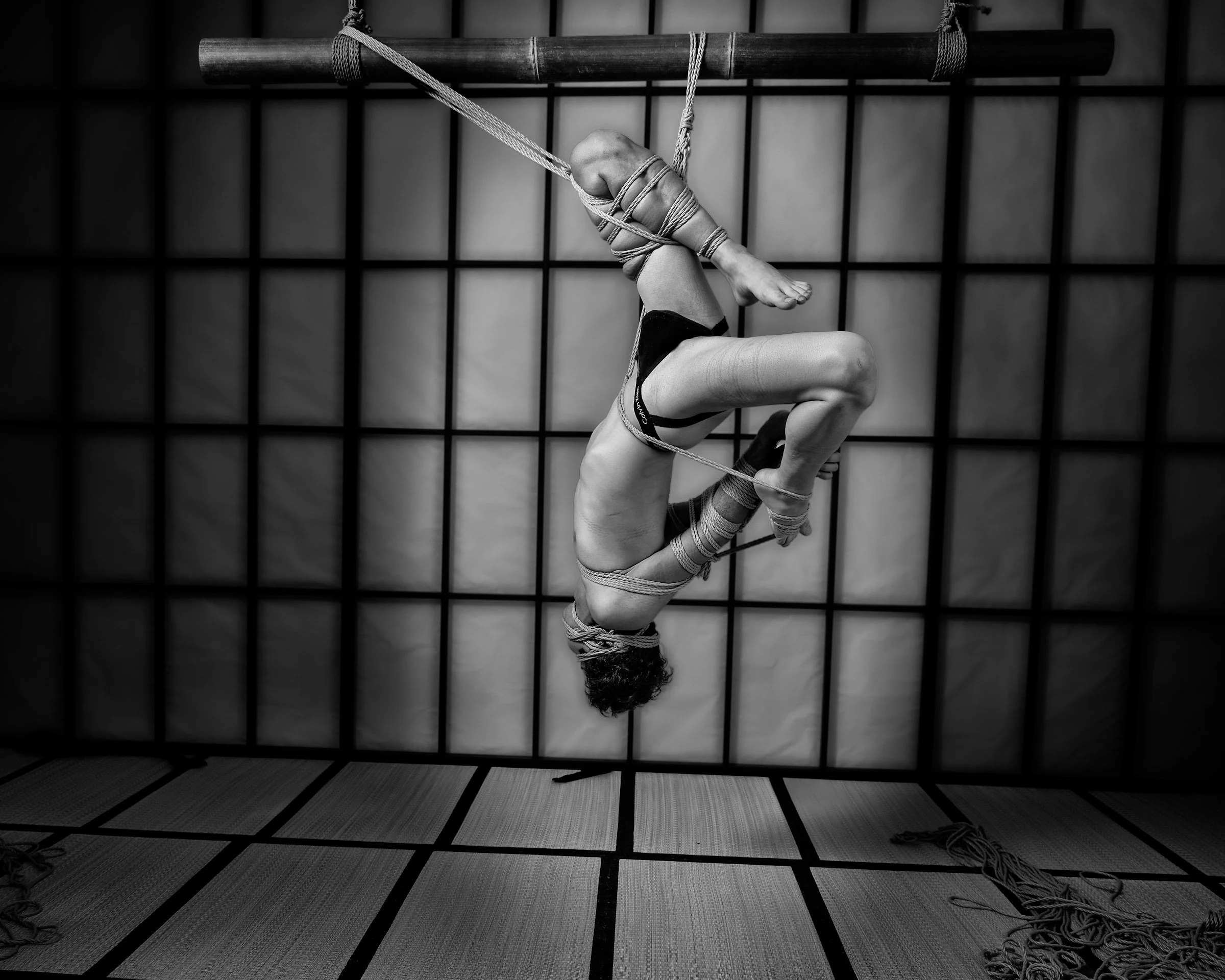
Ropes and photography by MALE SHIBARI, model Allan, shot at Shibari Studio Berlin