Sascha aka VÆGABØUND on Emotional Shibari, Naka Ryu & Erotic Flow
In this edition of Tension & Trust — the Shibari Studio Berlin Journal, I sit down with Sascha aka VÆGABØUND — a kink educator, Shibari artist, photographer, and entrepreneur behind an international rope business. We talk about what keeps someone devoted to rope for over a decade: not just technique, but presence, emotional depth, and the kind of connection that makes the rest of the world go quiet.
Sascha shares how his style evolved from “learning a bit everywhere” to finding direction through Naka Ryu, and later reclaiming eros by studying Yukimura Ryu — weaving lust, shame, seduction, and desire into a more holistic expression as a rigger. We also go into his pre-scene approach (his Erotic Flow bodyhandling, shaped by martial arts and dance), and why he believes you can create something meaningful with even one rope.
If you’re curious about Shibari as an art form, a practice of intimacy, and a craft rooted in safety and attention — this interview is a grounded, honest deep-dive.
Who are you and how do you like to be introduced?
My Name is Sascha aka VÆGABØUND. I am a Kink-Educator, Shibari-Artist, photographer and entrepreneur with an international rope-business.
How did rope first show up in your life, and what made you stick around?
Ropes first came into my life when I decided to explore a long-ignored kinky side of myself more than ten years ago. At first, I saw them simply as a more beautiful alternative to handcuffs or shackles. But through my play partners at the time, I eventually discovered Shibari. Its presence and mindfulness, its aesthetic and artistry, and - last but not least - its emotional depth made me fall in love with it quickly. The connection it fosters, the beauty it brings out in my partners, and the way it allows me to express myself kept me committed to it, even when the journey was sometimes rough along the way.
What does Shibari mean to you at this moment of your life?
Shibari reflects my personal and emotional journey in this moment of my life - as an artist, as an educator, and most of all as a human being, with all my light and all my shadows.
How would you describe your rope in three words? And why these three?
Emotional, Entrancing, Explorative
Emotional: Emotions are the essential ingredient of a fulfilling session. Their ebb and flow are what makes each experience uniquely its own. Creating a space - a scene - that invites, evokes, and transforms feelings for both my model and myself is the central reason I do this.
Entrancing - When I tie, I want to create a moment where only my model and I exist—a space where the ties literally bind our attention and emotions to each other. Everything else fades, becoming irrelevant. It feels like stepping into a magic circle, one untouched by time or distraction.
Explorative - I see my sessions the way I imagine jazz: beginning with a theme, perhaps a first tie, and then discovering where to go from there, guided by my models, their emotions, their movements, and the inner stories I see unfolding. With each rope, each touch, each exchange of gaze, I choose whether to support their story as it emerges or weave in my own tune - adding emphasis, contrast, or a subtle redirect to the flow of the moment.
If you could clear up one big misconception about Shibari, what would it be?
Shibari doesn't have to be complicated. You can have beautiful, deep moments with even one rope. That being said, the more you have mastered your instrument, the more you can express yourself.
How did your technical style evolve and who or what shaped the way you tie?
When I started out with Shibari, I had no real sense of the different styles. I simply wanted to tie better, tie safer, and foster deeper connections through rope - but I had no clear direction. I learned bits and pieces wherever I could, and although I knew four versions of the gote, I didn’t truly understand any of them.
My biggest influence arrived almost six years ago in the form of a new partner - now an extraordinary rigger herself - who took me to a workshop that introduced me to Naka Ryu. I was immediately captivated by the philosophy and aesthetics of the style. The partner who followed shared the same enthusiasm, and together we walked that path for the next four years. (She, too, has since become an incredible rigger.) I’ll always be grateful to these remarkable women for the part they played in my growth.
Over time, though, I noticed that as my technique sharpened, my sense of eros had quietly slipped into the background. My recent journey has been about reclaiming and expanding that part of myself by studying the more overtly erotic Yukimura Ryu - exploring themes of lust, shame, seduction, and desire - and blending these qualities with Naka Ryu to create a more holistic expression of my many embodiments as a rigger. This exploration, once again, has been inspired and encouraged by a remarkable partner of mine.
Layered into all of this is my own way of moving, touching, and witnessing the person I tie, shaped by years of martial arts and dance. And at the heart of it all is my desire to bring presence and sensuality - whatever shape they take - into every session.
Do you have a pre-scene ritual as a rigger, or how do you bring yourself into the right head-space?
My way of stepping into the right head-space starts with the first, grounding touch with my model. Breathing together gazing into each other's eyes, touching with intent and presence, shaping and guiding her/them through a form of Body-handling that I've developed over the years from my experience of martial arts and dance and which I teach as erotic flow to my students as well. A session doesn't start with the first rope. It starts with intent, with the interdependence of guidance and surrender. It starts with the somatic embodiment of both roles as a top and bottom. Everything else evolves from there.
How do you tie in a session – what influences it, and do you plan ahead or go with the flow?
This can vary a lot. Some sessions follow a purpose we set together beforehand — a particular shape, a specific emotional quality, a certain dynamic we want to explore. But most of my sessions are shaped by the moment: by subtle cues in my model’s body, by their personality, their emotional state, the way our dynamic develops in real time.
A friend I tie with once said, ‘The exciting thing with you is that I never know how the session will unfold… and sometimes it feels like all emotions appear within a single tie.’ That’s exactly the space I try to co-create and hold - a space where vulnerability, curiosity, and trust can meet, unplanned and alive.
If someone wants to explore being tied for the first time, what would you tell them?
I’d recommend informing yourself beforehand. Shibari is beautiful, but it comes with real risks. Make sure the person you tie with is trustworthy and experienced. Take your time — don’t rush. Start on the floor and pay close attention to how your body responds. One of the safest ways to explore is by booking a private session with a professional rigger, who can guide you through technique and safety.
What’s one thing you wish you had known at the beginning of your rope journey?
I am tempted to say: Knowing more about the scene and styles to find my way earlier. But then again, this is part of my journey - and everything unfolds in its own time.
If your rope style were a movie or a song, what would it be?
“Hungry Eyes” by Eric Carmen ;)
In Summary
Sascha aka VÆGABØUND describes Shibari as a mirror of his personal journey — light and shadow included — and defines his rope in three words: emotional, entrancing, explorative. He explains how his technical path was shaped by Naka Ryu’s aesthetics and philosophy, and how studying Yukimura Ryu helped him bring eros back into the foreground.
Central to his sessions is the idea that a scene begins before the first rope: with intent, touch, breath, and the shared embodiment of both roles. He also highlights beginner safety, encouraging newcomers to learn risks, move slowly, start on the floor, and seek trustworthy, experienced guidance.
More from Sascha here: www.vaegabound.com & www.atelier-aeos.com
Experience Shibari in a guided setting.
Presense
•
Polarity
•
Connection
•
Small group of max. 4 couples
•
A guided intimacy practice in Berlin-Mitte
•
Presense • Polarity • Connection • Small group of max. 4 couples • A guided intimacy practice in Berlin-Mitte •
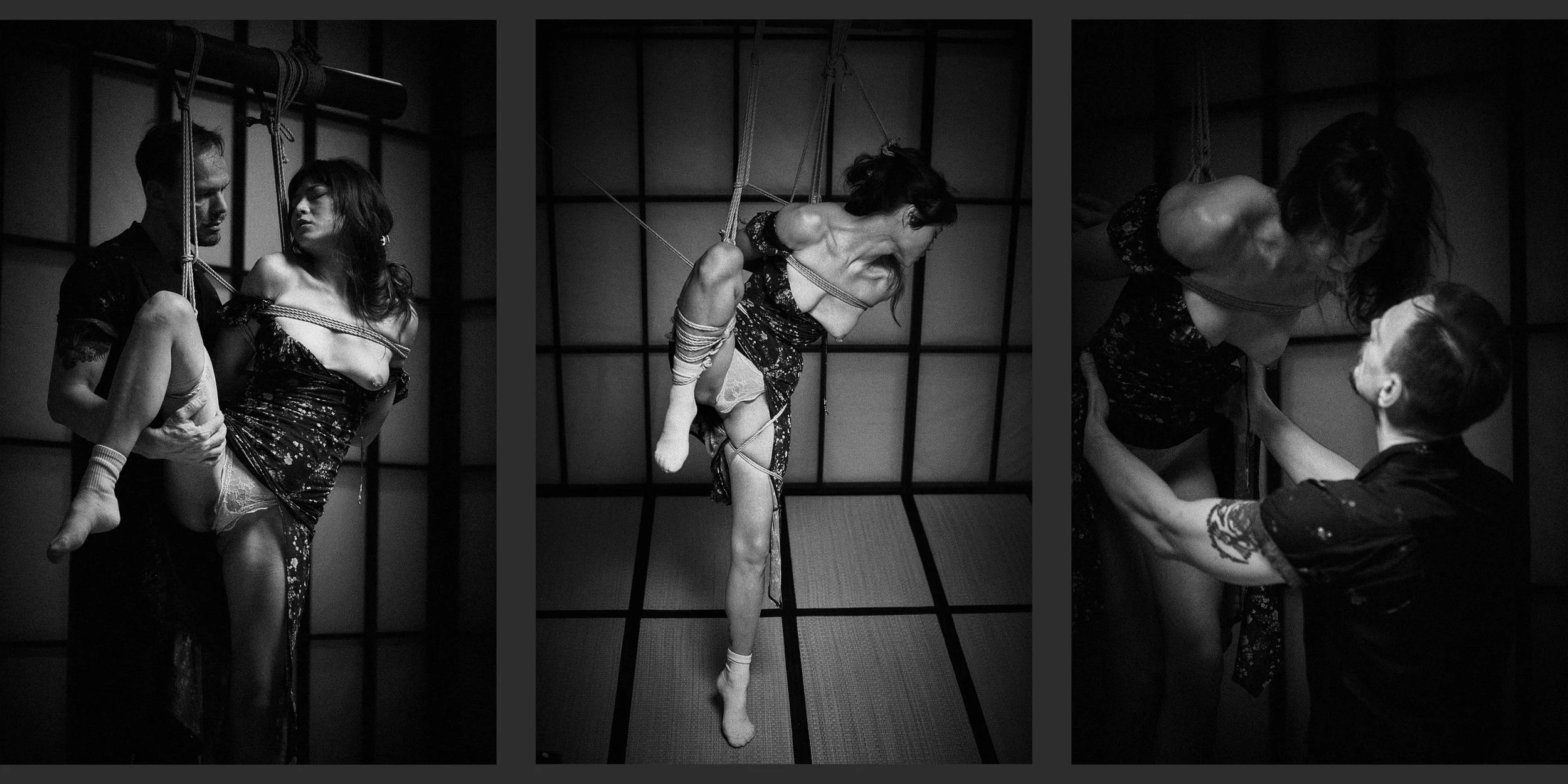
Photo story with Shibari rigger VÆGABØUND and Model Mai Le, shot at Shibari Studio Berlin by Dan Carabas.
Ready to go deeper in our 1:1 offer?