Restriction, Exposure & Connection – An Interview with Shibari Rigger Davide “Laodai”
Davide – better known in the Shibari community as Laodai, a name gifted to him while living in China – is a professional rope rigger whose life is deeply intertwined with Japanese rope bondage. Shibari is his main job, but he refuses to become just another “product” in the growing BDSM and kink market. Instead, he keeps his practice rooted in what rope truly means to him: restriction, exposure, and connection as pathways to real happiness for him and his models.
In this interview for the Tension & Trust Journal, Davide shares how one photo of his ex-girlfriend tied in ropes completely shifted his life, how his technical style evolved from real sessions rather than trends, and why risk awareness is always his first priority. He talks about staying authentic in a scene that often romanticizes Japan, the importance of keeping space for life outside of kink, and why every rope session should be a shared journey rather than a performance for the crowd.
Who are you and how do you like to be introduced?
My name is Davide, also known as Laodai, which is the name the community gave me when I was in China.
How did rope first show up in your life, and what made you stick around?
The very first trigger point was when my ex-girlfriend showed me a picture of herself tied up. I felt a multitude of emotions and realized the potential that ropes can have.
What does Shibari mean to you at this moment of your life?
It’s my main job, so it’s a big part of my life. I try not to turn myself into a product for the mass market that Shibari is becoming. I try to keep my identity and stay true to what ropes mean to me, and I feel happy doing it. A very smart person once told me, “Never let ropes and BDSM become your whole life; always keep room for other people and other interests.” I completely agree with that, and I’m trying to live by it.
How would you describe your rope in three words? And why these three?
Restriction, Exposure, and Connection. These are the fundamental elements always present in my sessions and performances. These three aspects help me and the models (who enjoy this way of tying) to reach happiness.
If you could clear up one big misconception about Shibari, what would it be?
Haha, there are so many. I’ve always thought about doing a workshop about respectfully de-romanticizing Japan and the Japanese rope scene for Western people. But then I saw that some people are genuinely very happy with that, they really smile and live it with so much passion and dedication. It felt like telling kids that Santa Claus doesn’t exist, so I’ll never do that. Who am I to take happiness away from people’s rope lives? But there’s one thing I’d like to say: please stop using words like aibunawa or semenawa as if they were ingredients, categories, or something you can achieve by following “instructions.”
How did your technical style evolve and who or what shaped the way you tie?
I define myself as a professional rigger, not a teacher, not an educator, not a content creator… That means my job is tying people. My style and techniques evolve to achieve goals and solve the “issues” I encounter while tying. Our goal is to reach happiness through ropes; if I can change even a tiny detail to make that happen faster or easier, I will. But the first priority is always risk awareness and risk control.
Do you have a pre-scene ritual as a rigger, or how do you bring yourself into the right headspace?
Not really. Usually, right before a session, I think about how life and humanity suck, and that the next hour will be like a diamond in a pile of shit, a chance to love, a memory that can make it all worth it.
How do you tie in a session – what influences it, and do you plan ahead or go with the flow?
I tie in a very deep and emotional way. There’s never a plan; I listen to what the model wants, and I listen to what I want. For me, it’s very important to “do it together.” Compromise is fine, but never sacrifice.
If someone wants to explore being tied for the first time, what would you tell them?
Don’t let anyone push you into doing something you don’t like.
What’s one thing you wish you had known at the beginning of your rope journey?
To buy and hold Bitcoin.
If your rope style were a movie or a song, what would it be?
Not a movie, but an art installation: Rest Energy by Marina Abramović.
A song: Opus by Eric Prydz.
In Summary
In this conversation, Davide “Laodai” describes what Shibari means to him at this moment in his life: it is his main work, but never his entire identity. He explains how his rope style developed through countless real sessions, always refining techniques to reach emotional intensity faster while keeping risk awareness and safety at the core. For him, restriction, exposure, and connection are the three pillars that define his way of tying and the key to creating happiness for both rigger and model.
Davide also addresses common misconceptions around Japanese rope bondage and the way Western communities romanticize Japan and specific Japanese terms. Rather than treating words like aibunawa or semenawa as recipes or categories, he invites people to look beyond labels and focus on what they actually feel in their bodies and relationships. His sessions are never fully scripted; he listens to his model, listens to himself, and builds each scene together, accepting compromise but never self-sacrifice.
For newcomers who want to experience being tied for the first time, his advice is clear: never let anyone push you into something you do not truly want. And in a very Davide way, he closes with a wink at the wider world: if he could go back to the beginning of his rope journey, he would also tell himself to buy and hold Bitcoin. Between references like Marina Abramović’s “Rest Energy” and Eric Prydz’s “Opus,” this interview paints his rope not just as Shibari or BDSM, but as an intense, precise, and deeply human art form inside a chaotic world.
Experience Shibari in a guided setting.
Presense
•
Polarity
•
Connection
•
Small group of max. 4 couples
•
A guided intimacy practice in Berlin-Mitte
•
Presense • Polarity • Connection • Small group of max. 4 couples • A guided intimacy practice in Berlin-Mitte •
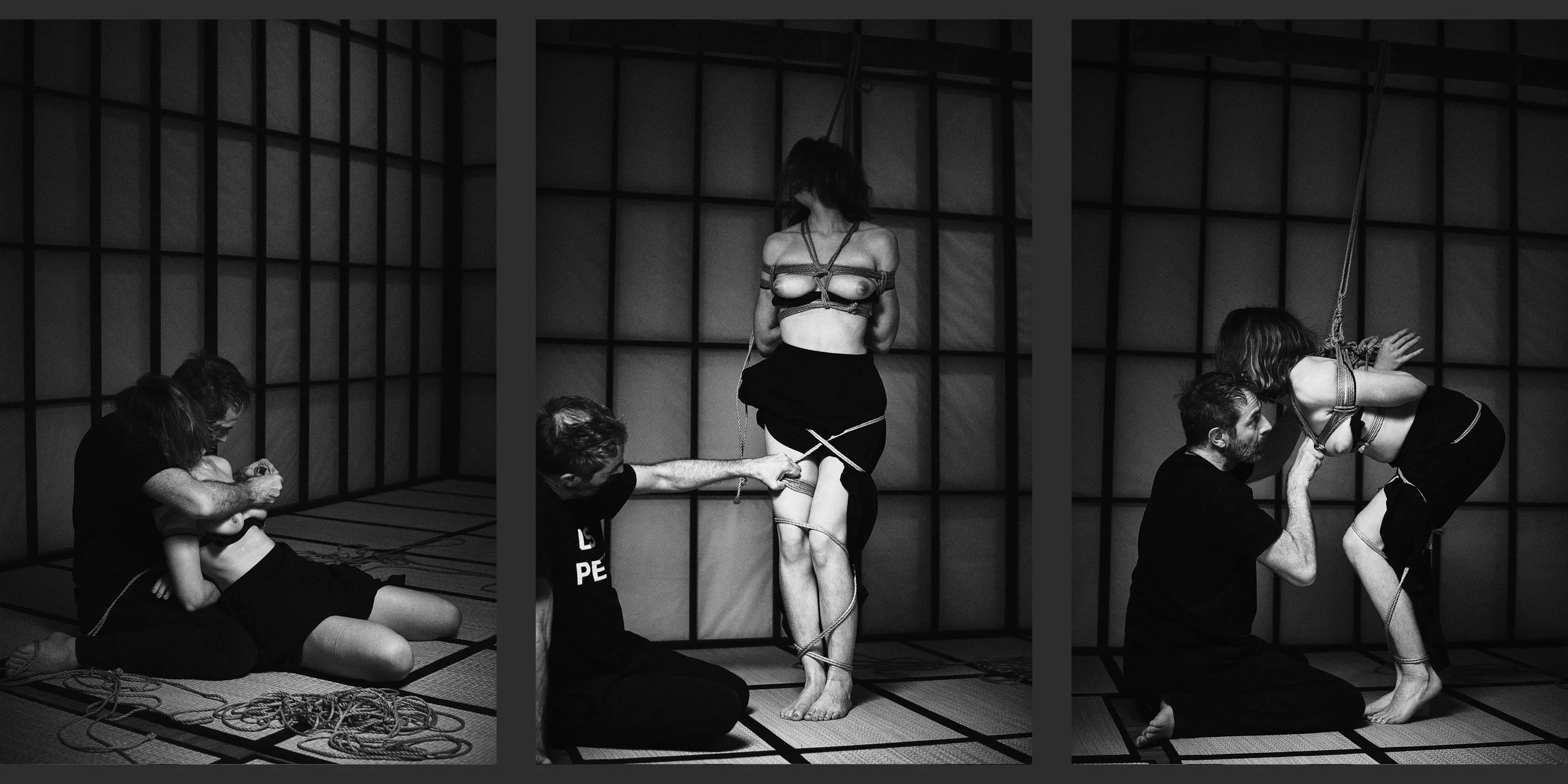
Photo story with Shibari rigger Davide “Laodai” and Model Dorcara, shot at Shibari Studio Berlin.
Ready to go deeper in our 1:1 sessions?